Home / Resource Center / Flooring / LVP
Flooring · 7 min readWalk into ten recently remodeled homes in Fort Myers or Cape Coral and you'll find luxury vinyl plank in seven of them. That's not a fad. LVP earned its place as Southwest Florida's default flooring because it's waterproof, tough underfoot, and looks more like real wood every year. Here's what it actually costs installed, how to tell quality product from bargain-bin product, and where it does (and doesn't) make sense.
The short answer is water. A quality LVP plank has a fully waterproof core, so the things that ruin wood floors here — 70%+ humidity, wet feet from the pool, AC condensate drips, the dishwasher line that lets go while you're at work — simply don't faze it. It's also warmer and quieter than tile, easier on knees and dropped glasses, and it usually installs directly over an existing slab or even old tile with far less demolition and dust.
One honest caveat: waterproof plank is not the same as a waterproof floor. Storm water that sits for days can still get under the planks and reach the slab. LVP survives events that would destroy hardwood, but standing water still needs to be extracted quickly.
Materials run roughly $2–$7 per square foot depending on wear layer and core quality. Installed, most Southwest Florida projects land between $4.50 and $9 per square foot all-in. The spread comes almost entirely from prep and extras: leveling an uneven slab, removing and reinstalling baseboards, moving furniture, and stair treads (stairs are always priced separately).
Worked example: a 1,600 sq ft home typically runs $7,500–$14,000 complete — mid-grade SPC plank, normal slab prep, baseboards reset and caulked. If a quote comes in under about $3.50/sq ft installed, look hard at the wear layer spec and ask what prep is included.
SPC (stone plastic composite) cores are denser, more dent-resistant, and more dimensionally stable in heat — the better pick for sun-drenched rooms, converted lanais, and homes that sit unconditioned part of the year. WPC (wood plastic composite) is softer, quieter, and more comfortable underfoot — a fine choice for bedrooms in a home where the AC runs year-round.
Ignore the marketing names and read the wear layer spec. 12 mil is the sensible minimum for a family home; go 20 mil if you have big dogs, rent the property, or just want it to still look new in year ten. Total plank thickness matters far less than that one number.
LVP is the right call for bedrooms, living areas, home offices, and whole-house continuity — one floor flowing through every room with no transitions. It's also the fastest way to modernize over dated tile without a demolition project. Tile still wins in showers and wet bathroom floors, on open lanais that take direct rain, and in some luxury resale markets where buyers expect porcelain. We break that comparison down in our tile flooring guide, and our Florida flooring overview covers every option side by side.
Most LVP problems in Southwest Florida trace back to installation, not the product. The slab should be moisture-tested and flattened (self-leveler where needed) before the first plank goes down. The manufacturer's expansion gap isn't optional — Florida heat will expand planks in rooms that aren't conditioned around the clock, and a floor installed tight to the wall will buckle. Planks should never be pinned under cabinets or heavy built-ins, and product should acclimate in the house, not the garage, before install.
The plank itself is — the core won't swell or warp. But water can still travel through seams and edges to the slab beneath, so spills are no problem while flooding still needs prompt extraction. For rooms with drains or true wet areas, tile remains the better choice.
Quality plank with a 20 mil wear layer routinely goes 15–20 years. The main Florida-specific risk is UV fading in front of big unshaded sliders — window film or a rug in the sun path solves it.
Usually yes, if the tile is flat and well bonded. Grout lines get skim-coated so they don't telegraph through thinner planks. This saves the cost, mess, and days of demolition.
Most Southwest Florida jobs land between $4.50 and $9 per square foot including mid-grade or better material. Quotes far below that usually mean a thin wear layer or skipped slab prep — the two corners that cost you most later.
Keep planning with these:
We install LVP across Fort Myers, Cape Coral, and the rest of Southwest Florida — and because we're painters too, the baseboards, caulk lines, and touch-ups after install come out right. Estimates are free and in writing: request an estimate whenever you're ready.
Floors in Southwest Florida live a hard life: 70%+ average humidity, sand tracked in year-round, and the occasional tropical-storm water intrusion. Some materials shrug all of that off; others swell, cup and delaminate. Here's the honest rundown.

Wood and wood-based products absorb moisture from the air and expand. In climates with dry winters, they get a chance to shrink back. Here, they don't — which is why solid hardwood is the riskiest common flooring in coastal Florida, especially in homes that sit closed up over summer.
Effectively waterproof, immune to humidity, and cool underfoot. The weak point is grout, which stains and grows mildew if left unsealed. Sealing grout every few years keeps tile floors looking new for decades.
The go-to wood look for Florida. Fully waterproof cores, no swelling, and modern lines are convincingly wood-grained. Choose a thicker wear layer (20 mil+) for pets and rentals. One caveat: extreme heat in unconditioned rooms can expand cheap LVP — buy quality and follow expansion-gap specs.
Cross-ply construction resists humidity movement far better than solid wood. If you want real wood in SWFL, engineered is the way — kept in a consistently air-conditioned home.
Beautiful, but it moves with every humidity swing. Expect seasonal gapping and cupping unless the home's climate is tightly controlled year-round.
For garages, lanais and modern interiors, sealed concrete is bulletproof. Epoxy and polyaspartic coatings turn a garage floor into a showroom surface that laughs at humidity, tires and spills — and they're a natural companion project to a repaint.
A worn garage floor or a slick painted lanai is often a coating problem, not a replacement problem. Polyaspartic systems cure fast, resist UV yellowing (epoxy's weakness in sunlit spaces), and can include anti-slip texture — worth asking about before you rip anything out.
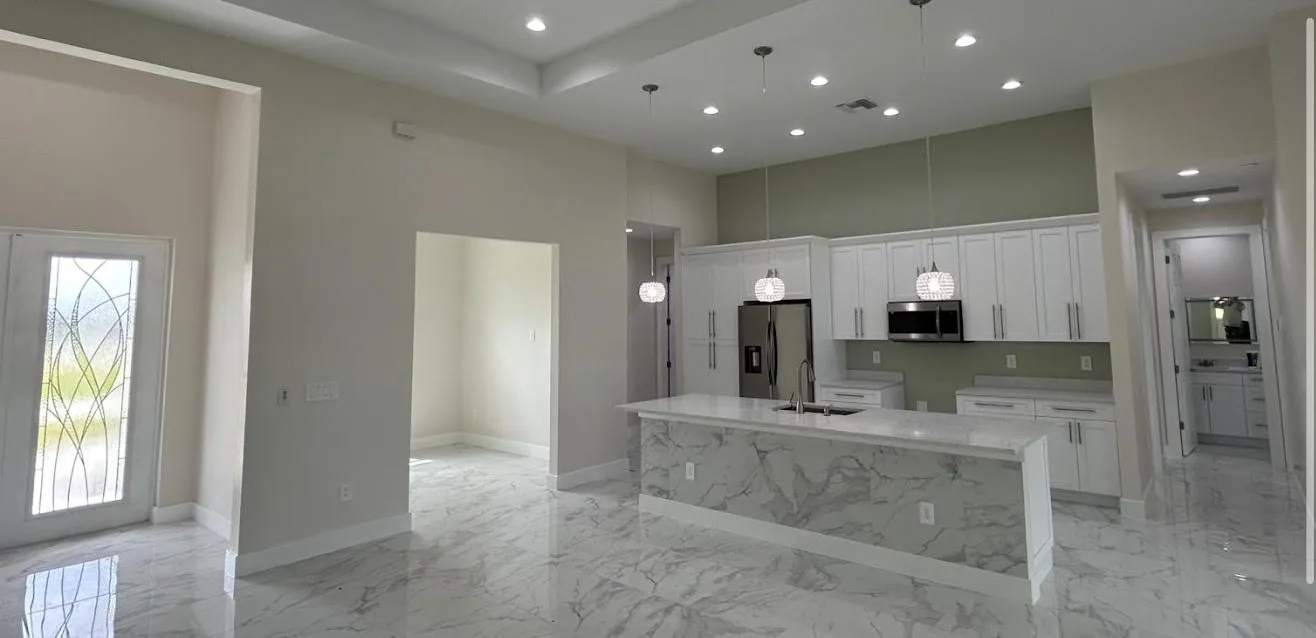
Porcelain tile, luxury vinyl plank and sealed or coated concrete handle Florida humidity best. Engineered hardwood works in consistently air-conditioned homes; solid hardwood is the riskiest choice.
Quality LVP with a rigid waterproof core performs very well. Cheap products in hot, unconditioned rooms can expand - follow the manufacturer's expansion gap and keep sun-baked rooms ventilated.
Polyaspartic resists UV yellowing and cures faster, making it better for garages and lanais that get sunlight. Epoxy remains a solid budget option for fully shaded floors.
You can, but expect seasonal movement like gapping and cupping unless humidity is tightly controlled year-round. Most flooring pros recommend engineered wood or LVP instead.
Planning the work? These guides from our Pricing Center cover the costs:
Free estimates. Fast responses. A finish you'll be proud of.
Get a Free Estimate Today